

I. Why Conduct Vibration Monitoring for Brake Motors?
As a key component in industrial equipment, the operating condition of brake motors directly affects production safety and efficiency. Vibration monitoring can capture abnormal signals during motor operation, delivering the following core value:
Fault warning and prevention: Abnormal vibration in brake motors may be an early signal of issues such as bearing wear, rotor imbalance, and electromagnetic interference. Real-time monitoring enables early detection of hidden dangers, preventing sudden failures that could cause equipment damage or production interruption.
Reduced maintenance costs: Regular vibration analysis can accurately identify fault types (e.g., gear faults, misalignment), reducing blind repairs and downtime while extending equipment service life.
Ensured production safety: Brake motor failures may trigger chain reactions and even lead to safety accidents. Vibration monitoring provides a "shield" for safe equipment operation, which is particularly critical in automated production lines.
II. Implementation Methods for Brake Motor Vibration Monitoring
1. Selecting Appropriate Sensors and Equipment
Vibration sensors: Commonly used types include acceleration sensors (measuring vibration acceleration), velocity sensors (monitoring vibration velocity), and displacement sensors (directly reflecting vibration amplitude). They are installed at key positions such as motor bearing housings and casings.
Intelligent monitoring equipment: Examples include digital vibrometers and data recorders (e.g., MR6000), which support multi-channel data acquisition, spectrum analysis, and remote monitoring, and can simultaneously measure parameters such as vibration, torque ripple, and current.
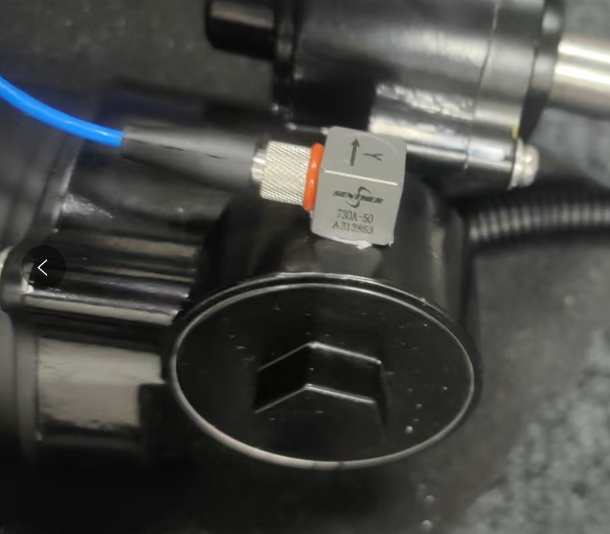
730A-50 Miniature Triaxial IEPE Accelerometer (Senth Technology)
The 730A-50 miniature triaxial IEPE accelerometer is an IEPE triaxial miniature acceleration sensor. This model uses shear-mode piezoelectric ceramics as the sensing element and features an ultra-wide frequency response. By combining high-quality crystals with low-noise microelectronic components, this IEPE accelerometer generates signals with ultra-low temperature sensitivity variation/response across its operating temperature range compared with other sensing elements. The shear-mode technology also ensures excellent base strain sensitivity error. The 730A-50 miniature triaxial IEPE accelerometer adopts a laser-welded titanium alloy metal housing and a glass-sealed 4-pin lightweight connector structure (or integral cable output) for lightweight, wide-bandwidth applications. Excellent amplitude and phase frequency response make this product ideal for structural verification, component testing, drop testing, and laboratory hydrodynamic testing. The miniature cubic structure allows test engineers to conveniently measure acceleration along three mutually perpendicular axes simultaneously, with reliable test data and long-term stability.
2. Standardized Testing Procedures
Installation and calibration: Ensure the sensor is securely mounted to avoid interference; equipment must be calibrated in advance to ensure measurement accuracy.
Parameter settings: Select the sampling frequency (e.g., 200 MS/s) according to motor operating conditions, set vibration thresholds (e.g., ISO 10846 standard), and record baseline data.
Data acquisition and analysis:Combine time-domain waveforms, FFT spectra, historical baselines, and vibration differences under various brake operating conditions for comprehensive fault diagnosis.
Time-domain analysis: Observe whether the vibration waveform is stable and determine whether impact or periodic anomalies exist.
Frequency-domain analysis: Identify fault frequencies via FFT (Fast Fourier Transform) (e.g., bearing fault characteristic frequency 2×(0.4×n±1)×, where n is the number of rolling elements) to locate fault types.
3. Building an Intelligent Warning System
Real-time monitoring: Use IoT technologies (e.g., LoRa, 5G) to transmit data to the cloud, analyze vibration trends via AI algorithms, and automatically trigger warnings.
Remote management: Maintenance personnel can remotely view equipment status via mobile phones or computers and respond promptly to anomalies⁶.
III. Practical Application Cases and Future Trends
Case: A manufacturing enterprise detected bearing wear in a brake motor through vibration monitoring and replaced the component in advance, avoiding a major loss from a production line shutdown.
Trends: Sensors are developing toward higher precision and lower power consumption. Combined with big data and machine learning, predictive maintenance will further reduce failure rates.
Summary
Brake motor vibration monitoring is a core element of industrial equipment management. Through scientific methods and intelligent technologies, it can effectively enhance equipment reliability and safety. Enterprises should select appropriate solutions based on their own needs and incorporate vibration monitoring into routine maintenance systems to achieve the goal of "prevention over repair."
